
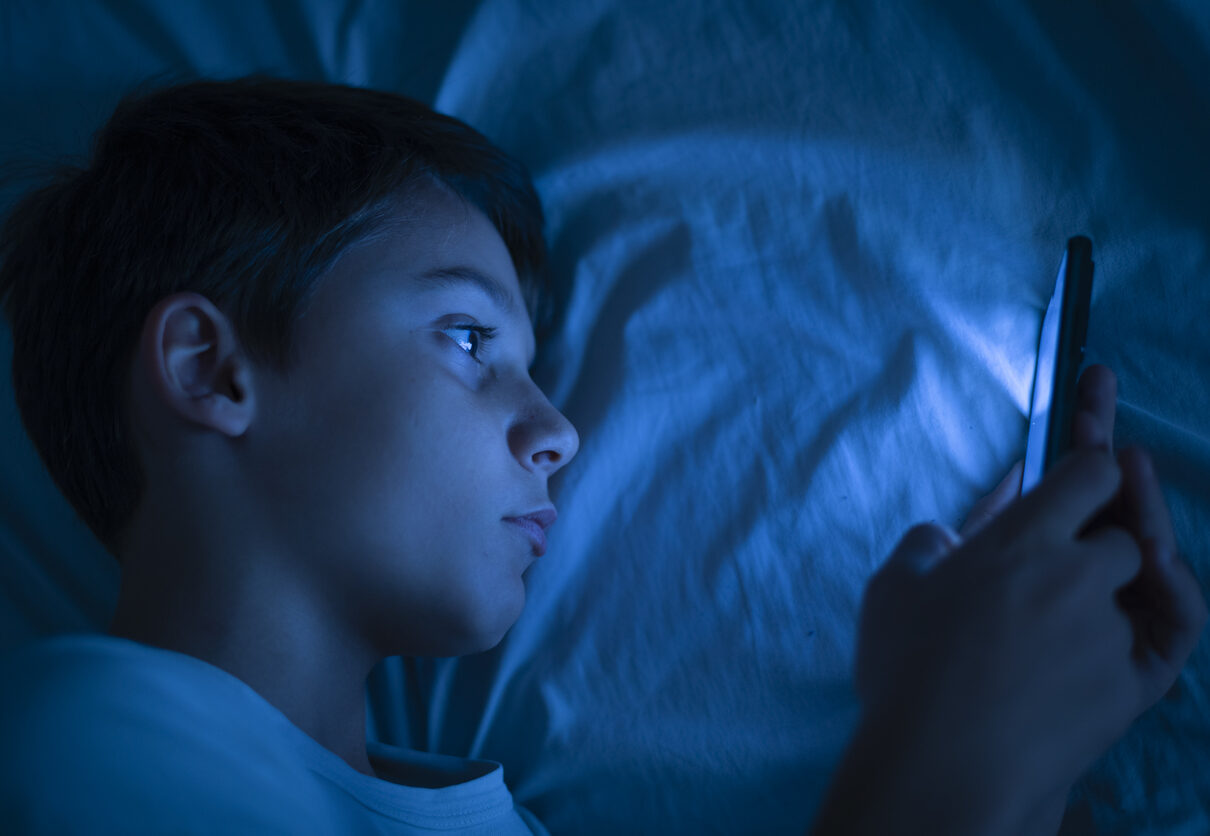
Young people sleep on average 2 hours too little each night
During the teenage years, the body undergoes major changes, both physically, cognitively and psychosocially. This is a familiar issue for most people. Many of us will probably also recognise that sleep is not so easy during this period of life. Why is that, and what are the consequences?
Consequences of sleep deprivation
Young people fat that sleep is important in order to be rested and energised for a long school day. If you haven't had enough sleep, you'll find it harder to get out of bed, and it will be harder to remember everything the teacher says. But sleep deprivation can also have far greater consequences for young people.
Too little sleep increases the risk of making small and large mistakes. We know that the frontal lobe, which controls much of young people's risk-taking, is not fully developed until later in their twenties. This combined with a lack of sleep is very unfortunate, as sleep deprivation in itself increases the chance of making incorrect risk assessments both in traffic and in life in general.
Several studies also show that sleep deprivation over time increases the risk of weight gain, diabetes and cardiovascular disease. These are health problems and diseases that cost the individual and society dearly. Insufficient sleep can also be linked to depression and other mental disorders. More and more young people are reporting mental health problems. This is a very complex problem, but lack of sleep is undoubtedly a negative factor in mental health problems in both young people and adults. Sleep is being researched around the world and new figures will constantly improve our insight into how much young people actually sleep.
Recommended sleep time
Young people under the age of 14 are recommended to get 9 to 11 hours of sleep per night, while for teenagers aged 14-17 this figure is 8 to 10 hours of sleep. A study from Iceland has measured teenagers' sleep duration to be well below the recommendations: as low as 6 hours on average per night. Only 10 % achieved the recommended sleep time on weekdays. Bedtime was found to be after midnight for 67 % of participants on weekdays. These figures tell us that young people are sleeping far too little. In fact, on average 2 hours too little every weekday. On the weekends, however, it looks different. Young people fall asleep even later, 93% going to bed after midnight. But here they sleep an average of 4 hours longer. That is, until well into the morning.
A common misconception about sleep is that you can make up for lost sleep. This applies not only to teenagers, but also to adults. You sleep less than the recommended amount of time during the week and will make up for it when the weekend comes. This has mostly short-term benefits. Yes, you'll feel more rested at the weekend, but the negative health effects of sleep deprivation over time will not be compensated for.

Sleep tips for teenagers
Be outdoors and get daylight every day, preferably in the morning
This will help your circadian rhythm. In the winter months here in the north, this isn't always easy to achieve, so a good tip is to get a daylight lamp that has a similar effect.
Don't sleep during the day, so-called "powernapping"
If you didn't get enough sleep the night before, it's tempting to go to bed after school. You should try to stay awake until the evening, and then go to bed a little earlier than usual that day. If you certainly not manage to stay awake, you should not sleep longer than 20 minutes.
Sleep at set times and get up at the same time every day
You've probably heard this several times. But it can have a big effect if you give it a real try over time. A fixed circadian rhythm will improve sleep and make it easier to fall asleep.
Avoid caffeine in the evening
Young people are drinking more and more energy drinks and caffeinated soft drinks, often while gaming or exercising close to bedtime. This can cause sleep problems, anxiety and anxiety symptoms. Also try to minimise your intake during the rest of the day.
Don't train too late
Exercise and physical activity have major positive health benefits and can also improve sleep quality. However, this should not be done just before bedtime, as the body becomes more active and switched on, which can lead to difficulty falling asleep.
Don't sleep with your phone
Light from your mobile screen can make it extra difficult to fall asleep. Try to leave your phone in another room when you go to bed.
Start the school day later?
One result of all the research done on adolescents and sleep is the "Start School Later Movement". This is a movement formed by healthcare professionals, sleep researchers, teachers, parents and students who want to spread information about the relationship between sleep and school time. They believe that students would benefit from starting school later.
This has also been researched and trialled on a small scale in Norway. For a period of time, 10th graders in Bergen started one hour later on Mondays. The results were that the pupils actually slept an hour longer on average on Monday night. They also performed better on reaction tests on Monday than on Friday of the same week. The researchers concluded that delaying the start of school can both prolong sleep and increase pupils' concentration in early morning classes.
Why is this the case? During adolescence, there is an imbalance between the internal biological clock and the typical start of the school day between 08:00 and 08:30. This internal clock determines which hours are favourable for concentration, and in adolescence these are shifted by almost three hours. The researchers believe that this means the following: if the alarm clock rings at 7am for a teenager, it will be the same as if it rings at around 4.30am for a teacher in their 50s.
It's not hard to understand that this is far from ideal for either individuals or society. At the same time, we also know that asking young people to go to bed earlier is not enough. Is the answer as simple as starting the school day later? Increased knowledge and research on this topic is therefore very important in order to understand how best to ensure that young people's sleep is optimised in a very important phase of their lives.
Sources
Hirshkowitz et al. 2015.
https://pubmed.ncbi.nlm.nih.gov/29073412/
Jefferson, R: Can you make up for lost sleep? 2019.
NHI: Thinks school starts too early in the morning. 2016.
https://nhi.no/familie/barn/mener-skolen-starter-for-tidlig-om-morgenen/
Rognvaldsdottir et al. 2017.
https://pubmed.ncbi.nlm.nih.gov/28449887/
Sleep Foundation: Teenagers and sleep. 2022.
https://www.sleepfoundation.org/teens-and-sleep
Start school later movement. 2022.
https://www.startschoollater.net/
Vedaa et al: School start time, sleepiness and functioning in Norwegian adolescents. 2011. https://www.tandfonline.com/doi/abs/10.1080/00313831.2011.567396
Walker, M: Sleep scientist warns against walking through life "in an under-slept state" 2017.
 EN
EN  NO
NO